Tuesday, June 19, 2012


June 17, Anchorage, Alaska.

This is our last night in Alaska. Tomorrow we hit the road for a very long, 700km haul to Beaver Creek, just inside the Canadian border in The Yukon. This route is unlikely to provide us with any more spectacular scenery, just the never-ending wilderness that is Alaska. That's not to disparage the wilderness, but just driving through it is very different to experiencing it as we have over the past two and a bit weeks.

So, what do we think of Alaska? Well, firstly, it isn't white, it's green, well, at least at this time of the year. Also, it isn't cold, well, at least at this time of the year. What it is mostly is a great adventure, truly one of the last frontiers, well, at least in the developed world. For Americans, travel to Alaska is a bit like Australians driving to Uluru, much of the thrill is just doing it. So imagine what it feels like for Australians coming to what, to us, is the absolute end of the earth! Then there is the wildlife, the glaciers, the mountains and the wonderfully friendly, though sometimes eccentric, people who eke out a living in what must be one of the most difficult regions to live on earth.


All this aside, Alaska does have some minor down sides. Don't expect attractive towns or cities. Alaskans need to do a bit of work on their urban environments. Sure, there are all the usual services, even fuel isn't a problem if you are aware of the great distances, but the frontier nature of the lifestyle does lead to some lax attitudes to tidiness. For example, there must be as many derelict vehicles rusting away in front yards and vacant lots in Alaska as are on the road. Piles of building materials and other junk are a constant eyesore. On the other hand, Alaskans would rather die than throw a drink can out the window on a highway. Go figure?

In short, Alaska is an adventure, beautiful, wild and still uncrowded. Do it, but please don't do a cruise, you'll 'miss the boat' on what Alaska is all about.


June 18, Beaver Creek, Yukon Territory, Canada.

Having done it, the 700kms from Anchorage to the Canadian border seems like a breeze. The good weather and great views for most of the way helped a lot. It was just more of the same old same old... incredible scenery at every turn! Does Alaska ever end? The distances are enormous and the country is so open and relatively untouched.


Finally, we have made it to Beaver Creek. Our last attempt to get here was foiled by a landslide that cut the highway a couple of weeks back. Not that Beaver Creek is 'the' place to be. It's just another tiny dusty strip of motels and gas stations. Just a place to sleep on the way to somewhere else. Mind you, Canada is not the accommodation bargain that the lower 48 states can be. Our motel tonight cost $104 for a room with no TV, no fridge, no coffee making, no free breakfast and what is worse for us, one power point! In Montana that $104 would get you a room big enough to hold a rodeo, corral for your horse, flat screen 200 channel cable TV, breakfast and dancing girls! The power point is for our travelling kitchen. This is what saves us heaps on these trips, but it does require power and as we have found out, our little portable hotplate draws a lot of current, blowing out the circuit breakers at least three times in motels we have stayed in so far. We just blame the hair dryer and get the office to turn us back on.

So tomorrow, off into the Canadian west in the path of Nelson Eddie and Jeanette McDonald. (look them up in your Funk and Wagnalls, or for non-boomers, just use Google.)


June 19, Whitehorse, Yukon Territory, Canada.

This is our second stay in Whitehorse, the capital of the Yukon Territory. Sad to say the better weather since our last stay hasn't improved our perspective on Whitehorse. One would need the rosiest of rose coloured glasses to find Whitehorse attractive. Sad, because it is situated in a very attractive part of the territory with high cliffs bordering the town on one side and views to snowcapped mountains on the other.

Another 500 km drive today through the wild Yukon this time. We had a few thrilling wildlife spottings with a mother bear and her two cubs ambling along beside the highway for a while. A bit further on solitary grizzly, probably a male, grazed beside the road. Later, a mother moose and her calf stopped us in our tracks.

We are finding Canada at least as expensive than Alaska. Petrol here is about as expensive as at home. In Alaska it was a little cheaper, but in the rest of the USA it is about $1 a litre at the moment. Motels are about the same as Alaska, $100 - $150 for a budget level room, which is around twice the price of the rest of the US. Food and booze are again expensive relative to the US, but probably on a par with Australia.

Saturday, June 16, 2012


June 16, Anchor Point, Alaska.

The village of Anchor Point was so named by Captain James Cook. Yep the same one; he sure got around! Poor James lost an anchor just off the point in the inlet that would eventually have his name. Cook Inlet divides the western Kenai Peninsula from the Aleutian Island chain that hooks its finger more than a thousand kilometres into the Bering Sea.


Our luck held again, with another spectacular day. Across the inlet, three snow-capped volcanoes Iliamna, Redoubt and Augustine, all over 10,000 ft, towered above the Aleutian Range, just a wisp of cloud floating around each summit. We must have taken a hundred photos before the day was out. Every few miles there was another lookout and another photo opportunity, each with something different to offer. Our favourite was the small village of Ninilchik with its bleached timber buildings, many built with the traditional dove-tail joint corners. On the cliff above the village stood a Russian Orthodox Church surrounded by an overgrown cemetery. To top off the scene, bald eagles swooped and dived above the cliffs.

Alaska is by no means a heavily populated state and it is rare to see crowds anywhere, but out on the sandy spit that reaches some 6 kms into Cook Inlet from the town of Homer, it was packed! More Rvs and trucks than we have seen in the two weeks that we have been in Alaska.


Our last stop was Anchor Point itself. Why? Anchor Point is the furthest west you can drive in the continental USA. Tick! And tick again, when we came upon several eagles on the beach, feeding on fish carcasses.


Friday, June 15, 2012


June 14, Seward, Alaska.

Every now and then chance rolls you a six. Today on our Kenai Fjord cruise, we had an experience shared by only a few people in the world (or so Capt. Dan told us.)

About an hour into our trip, under partly sunny skies, we came upon a half a dozen or so humpback whales engaged in a co-operative feeding manoeuvre known as combined bubble and lunge feeding. Whales surface, take in air, dive and blow out the air in a circle to 'net' a school of fish. Once the fish are encircled, the whales 'sing' a special call and they all lunge together up through the compacted school, breaking the surface with mouths open. The experience was further enhanced when the crew lowered their hydro-phone and relayed the calls over the ship's PA system. We had about a half an hour with the whales repeatedly circling, diving, calling and lungeing right beside the boat!

More was in store -otters, seals, porpoises and numerous birds. To top it all off were the glaciers. The last one we saw terminated in the sea. With the boat motor off, we floated in silence in a mass of float ice, as the groans and cracks of the enormous ice mass rolled over us.


Topped off with an Alaskan salmon, King crab and Prime beef dinner, I think we can call it a great day!


June 15, Soldotna, Alaska.

After all the excitement of yesterday's boat trip, it was nice to have bit of a quiet day today. The short drive from Seward to Soldotna on the other side of the Kenai Peninsula was through much the same landscape as the rest of Alaska. Just simply spectacular. However, it must be said that one can overdose on distant, snow-capped mountains, endless spruce forests and raging mountain streams. There was a bit more variety in the sorts of people out and about on this mild (10C) summer's day. It is the first day of the salmon fishing season and the trucks spiked with rods and nets were poked into every spare nook and cranny along the popular fishing spots on the Russian River. Huntin' and fishin' are, naturally enough, favourite summer past-times in this part of the world, and it's not just the Alaskans who partake. Many of our fellow travellers are up here for the summer salmon season.


Fishing is a serious business in these parts. First there is the license to be paid for. In some parts that can be a neat $40 a day. Then there's the special camouflage waders, shirts and vests. You know, the vests with the fly hooks sticking out of them. Top all that off with a floppy hat or jaunty cap with the brand of your favourite reel manufacturer prominently displayed and you are just about ready to go, well except for the rod, reel, tackle box, 'haul-out net' and, just to improve your chances, a pontoon boat to allow you to drift about.

In previous American blogs we have commented on the devastating impact of out of town shopping malls on small town America. In Alaska, the impact of this latter 20th century phenomenon is even more dramatic. Aside from the history of the original native peoples of Alaska, the state has little more than 100 years of history behind it. Up until 1867 when the USA purchased the, then, Territory from the cash-strapped Russians, there was little permanent settlement outside the native villages that dotted the rivers and suitable seaside locations. The Russians only established temporary fur trading settlements and a few church missions. There was little development from 1867 through until the gold rushes of the late 19th century. The gold boom bought thousands to the north and mining settlements mushroomed all over the Territory, some becoming substantial cities, in numbers at least.


As the Gold Rush petered out, most of the 'sourdoughers' (miners, so called because they carried yeast cultures with them to make bread) returned home to the south, some thousands died in the brutal conditions and a few hardy souls stayed on, to call Alaska home.

As late as the early 1940s, there was no road access from the lower 48 states to the Alaskan Territories. The war changed all that and the American and Canadian governments pushed through the Alaskan highway in 1944. When statehood was granted in 1949, Alaska was still very much the wild frontier. Virtually all that one sees in Alaska today is post 1945, so with such a short history, the towns and cities have suffered severely from the 'Walmart blight'. What is left is generally not a pretty sight. A few struggling businesses hold on amongst the crumbling ruins of the buildings of their previous competitors. With the severe winter conditions, buildings that are not well maintained quickly deteriorate and are eventually knocked down, leaving unnatural, overgrown open spaces in the middle of towns and cities, as shoppers and businesses move out to the city fringes to 'mall world'.

Some towns make a valiant effort to hang on to their short but interesting history. The 'City' of Kenai at the mouth of the Kenai River on Cook Inlet, is a good example. This was the site of one of the first Russian fur trading settlements. There was a fort here, built by the Russians and later taken over by the Russian-American Trading Company. The Russian Orthodox Church was established here in 1889 and the original church still stands today, the sole reminder of the original town. Sadly, the remainder of the historical walking tour featured buildings that mostly dated from the inter-war period or later. Some were younger than us! Sad, but at least they are attempting to hold on to their history.


Tuesday, June 12, 2012


June 8, Dawson City, Yukon

There are only two roads from the southern 'city' of Whitehorse, the capital of the Yukon Province, One runs north-west through the small border town of Beaver Creek via Haynes Junction. The other runs more directly north, to the historic gold rush town of Dawson City. Again, 'city' is a slight exaggeration.

With an early start from the fairly unremarkable 'town' of Whitehorse we took the southern-most route, heading off towards Haines Junction, 160 kms away. It was a bit of a rough drive, with scattered showers and poor visibility. Just outside Haines Junction, we hit a road block. Oh dear. A landslide had blocked the highway. The estimate for the re-opening was 2-3 days. Hmmm 2-3 days in the village of Haines Junction, Yukon. No! There was an option. The other route. Back to Whitehorse, another 160 kms, then 504 kms to Dawson City, a total for the day of over 800kms!

Tough as it was, all was not lost. The further north we went, the better the weather got. The temperature climbed to 24C and the sky cleared. The scenery was breathtaking. Snow-topped mountains gave way to wide glacial valleys and rocky hills, disected by swift rivers and streams. Regrowth is slow here. Areas devastated by wildfires are just beginning to regrow after almost 40 years. Luckily, the fires have not been widespread and the great majority of the forest is in its natural state. This part of the world is a true wilderness. No grazing, no farming, no fences, just forest as far as the eye can see for thousands of kms.
This change of plans will force us to take another long drive tomorrow to reach Fairbanks, where we have another hotel reservation. This is why we hate having to book ahead! Never mind. The drive is along what is known as the Top of the World Highway, reputedly one of the greatest drives in the world, and we have a good weather forecast.

One highlight of the day that we almost forgot... we saw our first bear! Just a small black bear, well actually it was a dark honey brown colour. Puzzled? Well as those of us who know our bears will tell you, the North American Black Bear can be any colour from black to dark brown and anything in between. The difference between the Black Bear and the much larger Brown Bear or Grizzly Bear, is more in the shape of the face and the pronounced hump that the Grizzly has.


June 9, Fairbanks, Alaska.

We started the morning with a quick tour of Dawson City. Despite the usual flood of tourists, and the associated 'clip joints', Dawson has managed to retain much of its early 20th century charm. The city once boasted a population in excess of 30,000, today it is down to 1500 souls, boosted to a few thousand when the 'buses come in'. The streets are gravel and the footpaths are boardwalks. Many of the original buildings have been restored and reborn as T-shirt shops or some other sort of tourist trap, but the main street still has a frontier feel and at the far end of the street there are several derelict buildings. Un-restored, listing heavily, they still provide a legitimate feel of the original town.

Dawson City lies on the confluence of the Yukon and Klondike Rivers, so it was to the ferry crossing that we headed after our quick walk up the main street. The ferry is free, but it is very small and the line of trucks and RVs waiting as we arrived seemed to threaten our plans for an early start to a hard day's driving to reach Fairbanks at a reasonable hour. Predictions for just the first half of our route, the Top Of The World Highway, were around 7 hours. Then we had another 400 kms into Fairbanks. Our worries were unfounded. There was a small vehicle line and we made the crossing within 30 minutes of pulling up.

So off we headed into the wilderness on a near perfect day, 24C and sunny and clear. About 80% of the Top Of The World is gravel, with the remainder being very poorly maintained paved surface. The gravel was fine, a bit dusty with some soft edges, but by Australian standards it was perfect. The paved sections were a nightmare of potholes and undulating surfaces. Enough about the road. The drive was all about the scenery. Wow. Distant snowy mountains, lush, deep river valleys, open, green alpine meadows and horizons that just go on and on. To date, we have driven around 2000 kms through the Yukon and Alaska and seen some of the best preserved wilderness areas we have seen anywhere. No fences. No farms, not even grazing. And so far we have only travelled in the most populated parts of this enormous region.

Almost at the end of the spectacular Top Of The World is the small village of Chicken, so named because the original miners who camped there couldn't spell Ptarmigan, the local bird that they wanted to name their camp after. Unashamedly a tourist stop, the village is still a hoot. Chicken paraphernalia is, of course, on sale. Derelict mining machinery, including an enormous dredge, litters the site. There are no real roads, just tracks of convenience between one place and the other; welcome relief near the end of a long, isolated drive.

Once the tourist haunts are left behind, Alaska and the Yukon are truly the last frontier. For those old enough to remember, every second man looks like Grizzly Adams, every second woman looks just like you'd imagine his wife to look like. Pick-up trucks out number sedans five to one, and almost very vehicle has some sort of damage. The locals are welcoming and, as usual in the US, polite to a tee, but one still gets the feeling that the locals crave the winter when they have this wonderland to themselves.

June 10, Denali RV Park & Motel, Denali.

Fairbanks is the second largest city in Alaska, with a population of about 100,000 for the whole area. The city itself has about 30,000 people. As cities on the world scale go, Fairbanks is a real minnow. Even so, we had expected something a little more, well, sophisticated. Poor old Fairbanks doesn't attract the tourist hordes and it struggles to do better than an overnight stopoff on the way to somewhere else. Most people pass through here on their way to Denali National Park or further north to the real Alaskan wilderness areas much further up towards the Arctic Circle. So sleepy old Fairbanks has a downtown that is just a hollowed out shell. Parking lots for the few government workers based here, the odd, very sleazy bar and a few red-neck classics like the Far North Tactical. 'Security through an Armed America' is their slogan and by the look of their headquarters in downtown Fairbanks, they mean it! As another indication of where the real soul of the metropolis lies, there are cage fights on this weekend, families welcome.

Fairbanks does however have a Walmart, a Supercenter to boot, with its own special brand of 'Walmart People' as featured in the many photo slideshows that do the rounds on the internet. If we were game enough we could have launched a whole new episode. So, stocked up with food for a couple of days, we hit the road for a very short 200km trip down to Denali.

For the second day in a row, the weather was perfect. Sunny, warm to hot, well hot at least for the Alaskans, and clear as a bell. Our digs are in what passes for a motel room in this part of the world, ok, but not the Ritz. Never mind, we only sleep here.

We ducked into the park this afternoon to check our bookings for the 12 hour bus trip through the park to Kantishna in the 'back country' as they like to say around here. As an insurance against a sudden weather change, we also did the only drive permitted in the park, a short 15 mile road to Savage River. As expected, the scenery was again just exquisite (we are running out of superlatives). We did manage to see a female moose, but that was all. We have much higher wildlife expectations for tomorrow's tour.

June 11, Denali RV Park and Motel, Denali.

It just had to happen. Our luck finally ran out and we awoke to a drizzly morning with low cloud and a little more chill in the air, probably somewhere around 11C.

By the time our Kantishna shuttle bus departed at 8:00am, the rain had stopped, but the clouds still hung low. We patted ourselves on the back that we had taken advantage of yesterday's weather to see at least the edge of the Denali in all its glory. Our trip was just the basic 12 hour shuttle bus, so there was the usual crowd of R-Vers and assorted other travellers, rather than tourists. A nice chatty crew of 30 or so, all Americans except for us.

By about 30 minutes into the trip the clouds lifted a little and visibility improved. All eyes were strained, searching for wildlife. Moose, caribou and bear were the main targets. Our first sighting was a small group of caribou well off in the distance, excitement enough, but when somebody yelled 'bear!!', shutters began to click in earnest. A beautiful dark brown grizzly was wandering along above the caribou.

There was some disappointment though. Denali/Mt McKinley, the highest peak in North America, deep in the park, and one of the truly iconic Alaskan images, was obscured by clouds and mist today. Our driver has seen 'The Mountain' only four times in six years. We were lucky enough to capture a glimpse of the mountain through the clouds at one point so at least we have that to remember.

Aside from a few spotty white Dall sheep, way off in the distance, our critter-spotting looked to be a bit of a washout as well, until the bus driver hit the brakes and yelled, 'bear on the road!' Lumbering along beside us was a champagne coloured grizzly, who seemed not the least interested in us. Even better luck followed as, just a little further on, we came across another bear and the shutters banged away again.

Americans of our age are a very gregarious bunch. Stand in a line waiting for a bus, or turn around in your seat once on the bus and you are bound to end up in a conversation, and it is amazing just how many common experiences we have with most of them, with the exception of having been in the military, which seems to be at least part of the career path of most American males.

Back at the RV park, now the sun comes out! And it's only 9:00pm, with at least 3 more hours before it sinks below the horizon for a few hours, to re-emerge at around 4:00am tomorrow! That's about 20 hours of sunlight a day!....

Thursday, June 7, 2012


June 5, Juneau, Alaska.

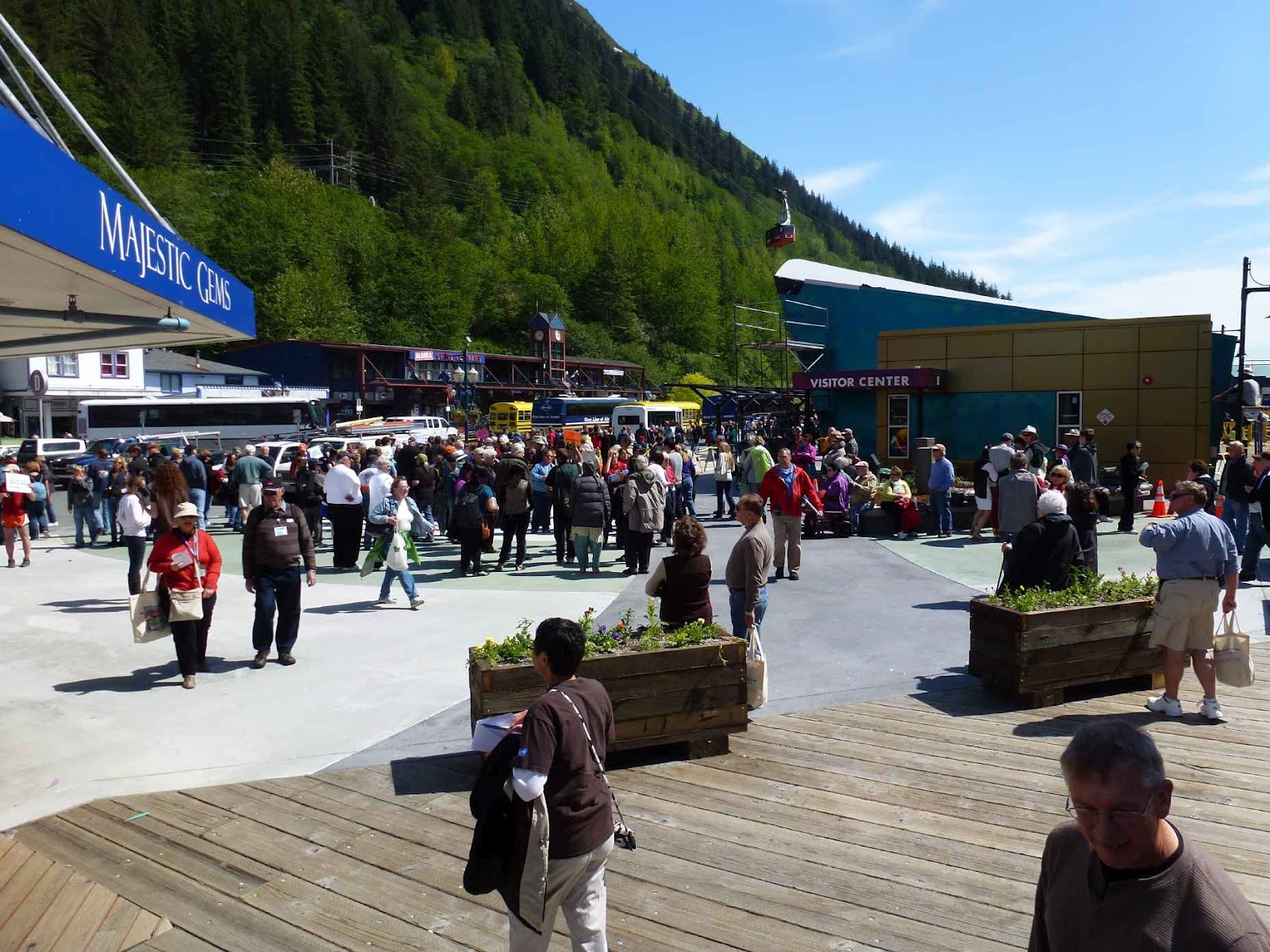
Yesterday we left the MV Columbia to spend a couple of days in Juneau, Alaska's capital. Juneau has a real frontier feeling to it. The RVs and trucks easily outnumber sedans, gun racks are common and most of the men folk look as though they are just heading off on a hunting trip. As with Ketchikan, the life of the city revolves around the daily arrival of the cruise ships. Not much moves until after lunch when the tourist hordes flow down the gang planks. Fleets of buses are parked ready to run the travelling punters out to the local sites. What a nightmare! Even out at the incredible Mendenhall Glacier, 15 kms out of the city, the buses were disgorging tourists as we drove in.


Despite the crowds, we gasped in awe as we stood before the solid wall of ice. 'Pups', ice blocks that had broken off the face of the glacier, floated serenely in the freezing glassy water and a powerful waterfall thundered down beside the ice flow.

Earlier in the day we caught the Mt Roberts 'Tram', a cable car that climbs 800 ft above the city for views up the passage. The story goes that there are 365 days in a year and in Juneau, it rains or snows on 300 of them. Our two days have happily fallen into the 60 fine days. It is difficult to imagine, but it was hot in the early afternoon yesterday, A fantastic day. Another early start tomorrow. Our last leg into Skagway departs at 7:00am with loading at 5:00am. Oh joy!


June 6, Skagway, Alaska.

Some serious beers at the 'World Famous' Red Dog Saloon in Juneau, and a dinner of Alaskan King Crab topped off Paul's 60th birthday celebrations. Well almost. Yet again, a couple of Americans we met in the bar picked up our bill. Yep, unbeknown to us, a couple from Colorado that we had chatted to for 30 minutes or so, left to catch their cruise ship, paying our drinks bill when they left. Again, you gotta love Americans!

Our early start this morning was just as painful as we had imagined it would be, but the pain faded as we were treated to yet another perfect day, warm, sunny and clear. On the 7 hour trip from Juneau to Skagway, we were kept entertained by porpoises, seals and humpback whales. Yet again, the Alaska State Ferry system has treated us to great staff, great service, great ship, great environment. As an example, on returning with our cups for the usual 'free refill' we asked to check if it was ok. “Not usually,' the cashier said, “but just go ahead”. That was four big coffees for $ 3.00 total. Just some serious attention to their slow vehicle loading procedures and we could easily give them Five Stars for value. No, this is not a paid advertisement.

As we turned the last bend of the Inner Passage into Skagway this afternoon, our hearts sank. There, lined up on the small waterfront were four enormous cruise ships. Our nemesis, the package tourist. Like hungry rats, they scurry off their ships, flood into towns in Alaska where they sometimes outnumber the locals by more than ten to one. This afternoon, the little town of Skagway, population 900, was engulfed by more than 5000 tourists, easily recognised by their T-Shirt Shop red carrier bags. Most of our travelling companions from the good ship MV Malaspina had the good sense to drive straight through town and head for the Canadian border and the Yukon Territory. Zig-zagging through the masses of people on the streets, we enjoyed the frontier feel of the 6 blocks of town that are part of the Klondike Gold Rush National Historical Park, with their wooden sidewalks and restored facades. We were also, luckily, on the spot when the daily, narrow gauge railway arrived back from its trip up to the summit of White Pass.

During our short visit in Skagway, we were able to join a very small audience at a great local stage show featuring the life and times of the local outlaw, Jefferson Randolph (Soapy) Smith, featuring dancing girls, gun fights and some 'history'. Many others also must have enjoyed the show. It has been running since 1923. Soapy was a conman, and at one stage the 'boss' of the lawless boom town of Skagway, then the gateway to the Klondike gold fields. Eventually, the locals tired of his scams, which included charging for cables on his telegraph which ran out of town only to end in the water just beyond sight. In a gunfight on the waterfront, Soapy was shot in the heart and died, a great character and very well promoted and well dramatised in this unpretentious show.

Tomorrow we'll follow our companions from the car ferry into the Yukon and far away from the threat of the cruise ship hordes.


Monday, June 4, 2012


June 1, MV Columbia, Alaska State Ferries.

Boarding the 'Good Ship Columbia' was not an illustrious start to our ferry cruise through the Inner Passage to Alaska. Dutifully arriving about fifteen minutes before the required check-in time of 3 hours prior to departure, we took our place in lane 8 as directed and awaited instructions. We are no novices when it comes to car ferry trips, terminals and boarding procedures, so we waited patiently to be called to drive up the ramp and board the ferry. So we waited and we waited...


Let us digress for a moment to the current state of the US economy and how American industrial might is being challenged by the Chinese and others. Cheap labour is often cited as the reason Asian economies can effectively compete against American industry. This may well true, but with the minimum wage in the US at just over $8.50 an hour, this is rapidly becoming a weak argument. No, what it is all about is efficiency.

At a time when the Greeks and Italians are the current international communities' 'whipping boys' when it comes to economic efficiency, it is interesting for us to return to our reflections on the loading of car ferries.

Aside from one best forgotten incident in the Greek port of Patras, when there was a problem with the ship, our experiences on European ferries have been way more pleasant that what we endured today at the Port of Bellingham, Washington. Four hours it took to load the ferry! People with clipboards and pens periodically ran up and down the rows of cars and checked windscreen stickers. Ours was checked at least three times by the same girl. One has to wonder why the ticket we were told to fix to our window had a barcode? Paper tickets and Ids were checked on entering the port area and then again at a booth on the loading ramp, one car at a time. It finally occurred to one of the sharper ticket checkers that it would save time if tickets were checked in the line. Good idea. Bad timing. There were only half a dozen vehicles left in line at that point. We, of course, were one of them.

Even the ever erratic Greeks and Italians can load a ferry with scores of large trucks, cars and assorted motorhomes in less than an hour!

We are finally on board and in our cabin. The purser had noticed that we were on board for two legs of the trip and had put us in the same cabin for both legs. Finally some sanity.


2 June, MV Columbia, Inner Passage, Canada.

Ferry cruising may not have all the luxury of a Four Star cruise ship, but what you see over the rails is exactly the same. The scenery, even through what is reportedly the less spectacular southern part of the passage is breathtaking, made even more so by some bright sunny weather and mild temperatures. Mind you, after 20 hours or so of pine-covered mountains, it becomes a bit like the Australian Outback; the first 100 kms are riveting, the next 1000 can be a bit same old, same old.

The lodgings aren't quite Four Star, but they are fully self-contained with a spacious shower, good water, wide bunks and plenty of storage space. In fact, our cabin is so large that it is probably twice the size of the hotel we stayed in in Tokyo on a recent trip.

Sleeping options on board range from our style of cabin to bunking down on the chairs in the lounges, sleeping outdoors in a heated 'solarium' area or pitching a tent on the front or back deck. The last of these, while probably a little uncomfortable, is certainly the most social.


Most people seem to carry on coolers with enough food and drink for the full voyage which, if you do it in one stretch, is three nights and three days. As you might imagine, our Esky had little room for food, so we've been eating in the cafeteria and restaurant.


June 3rd MV Columbia, Inner Passage, Alaska.

We broke our voyage today with a couple of hours on shore in the small Alaskan town of Ketchikan, once the 'Salmon Capital of the World'. Today it is probably more accurately described as the cruise boat capital. Three enormous liners disgorged thousands of tourists into the small downtown area as we wandered about the T-shirt shops and diamond 'outlets'. We had made a bad call in Bellingham when we boarded, opting to off load our car for the 6 hour stopover. Consequently, a fair portion of our time was spent getting on and off the ferry. Check-in time was two hours prior to departure, so once again we cooled our heels in line waiting for our turn to board.


Our day started well. The diner we selected for breakfast was the old style diner that we love and it seemed to be favoured by the locals. Just as we were inspecting our bill after struggling through another enormous American breakfast, the guy beside us at the counter lent over and said he would like to pick up our bill!. We were a bit taken aback, but he was genuine. He had had his breakfast tab picked up recently by a stranger and he felt he should return the favour. No strings. He just took the bill, paid it and disappeared. You gotta love Americans!


Touristy as Ketchikan is, it does have an interesting history. Once a major fishing port and a stepping off point for miners during the Klondike gold rush, the town, unsurprisingly, once boasted an active Red Light district. Most of the original brothels still stand along the boardwalks of Creek Street. Most are now a mish-mash of the usual tourist souvenir shops, but Miss Dolly's House has been maintained in all its early 20th century splendour. Miss Dolly was forced to close up shop, along with all her competitors along Creek Street, in 1954. Unlike the other Madams, Dolly stayed on in her house, keeping it fairly much as a time capsule until her death in 1972 aged 84.


After a quick trip to a totem pole museum, (probably not our last) we replenished our beer supplies and joined the line to load the ferry for Juneau.

Later in the afternoon we cruised into the tiny settlement of Wrangell, Alaska. Just a speck on the map, but apparently a great place to kill stuff! As we sidled up to the dock we were able to share a moment of true ecstasy with a few of the local lads as they unloaded an enormous black bear from the back of their pick-up. Dressed in camouflage, these 'good ole boys' were posing with their kill. This is truly the last frontier. “If you go out in the woods tonight be prepared for a big surprise' – 'specially if you are a bear!


After confronting the hoards of cruise boat tourists we are even more convinced that the local ferry trip was the best choice for seeing the Inner Passage. The pace is slow and the whole environment on board ship is laid back, friendly and extremely comfortable. Very few foreigners travel this way. There is a small sprinkling of Australians, a Kiwi or two, but that's it. The remainder of the passengers are American, mostly very average folk. Family groups and retirees predominate along with a few Alaskan locals returning home. Pick-up trucks and well used RVs fill the vehicle decks. Not a BMW in sight! All this is enhanced by fantastic scenery and mild, sunny weather.

Most people seem to survive on food brought with them or on snacks from the cafeteria. We have been frequenting the restaurant where meals are reasonable quality and excellently priced, particularly since tipping is prohibited because the staff are state employees.


Friday, June 1, 2012


May 27, Pacific Palisades, Los Angeles

Tirades about US Customs and Border Protection Officers have been a staple of earlier blogs on the good old US of A. We have been ignored, pushed about, treated with supreme indifference and, most annoyingly, kept waiting in never-ending queues. All of this applies mostly to New York it must be said, with officers we have dealt with in LA being slightly more accommodating. This time it was almost as though it was a different country. Airport staff welcomed us at every turn on the long walk to the customs check point, which was processed by efficient and pleasant staff. On to the luggage carousels. It was same old same old here, except that airport staff were in attendance helping to stack luggage as it tumbled out on to the carousel. They even helped the odd passenger retrieve heavy cases! No surliness, none of the practised indifference, just good service, yes service, from US airport staff and Customs officials. And it didn't end there. The shuttle bus to the hire car depot took some time to arrive, but nobody complained when the more than helpful driver leapt from his seat and helped load bags onto the bus.

Nothing like a sharp recession and high unemployment to put some focus back on service.


May 29, Motel 6, Seattle, Washington.

“On the road again...”

Had a wonderful time over the past few days with Anne-Marie and Ed (Paul's sister and brother-in-law) and their twin boys in LA.

Los Angeles is not everybody's cup of tea, but we have always had a great time here and even the traffic and the complete madness of the freeways, for us, is just what this city is all about. It is vibrant, creative, eccentric, enormously ugly, yet enthralling. A couple of days ago, the last day of the Memorial Day weekend, Anne-Marie and Ed took us for a drive up the coast from Pacific Palisades to Malibu and the fabulous Getty Museum, to get a feel for how the other half lives. Seemed like a great idea at the time, but we had grossly under-estimated the excitement of the first day of summer in this beach-mad city. Cars, cars, more cars and the people who emerged from them, crawled, lined up and strolled the 30 or so mile stretch between Malibu and Santa Monica. We sat in a restaurant at Sunset Beach and watched while people patiently waited at a full car park entry for up to an hour for the chance to get in. All went well until, after seeing many, many cars exiting the carpark and the Full sign remaining in place, things got a bit heated. The Beach Police intervened and calmed the situation. Made our lunch a whole lot more interesting. Later, in Santa Monica, we watched, from a distance as thousands of people streamed onto the already packed Pier.

Yesterday, our last in LA, we hit the Interstate to Palm Springs. Well, more correctly, to the enormous Outlet Mall situated 20 minutes west of the city. Luckily for us, Palm Springs was a city that we were happy to 'do' in a couple of hours, because most of our day was spent on the road and in the Mall. Bargain city! What was impressive, in a kitsch sort of way, was the 70 ft high statue of Marilyn Monroe that was moved to Palm Springs from Chicago just a few weeks before our visit.

Tonight, after our flight to Seattle, we are in a Motel 6, setting up our travelling kitchen purchased from Walmart. All the necessities, cooking plate, frypan, saucepan, plates, cutlery, esky and all the other bits and bobs are now neatly packed into our two roller-bags, ready to provide us with home-cooked meals for the next two months. We are “On the road again.”


May 31, Bellingham, Washington.

More time in the Outlet Malls today to capitalise on the extremely cheap clothing prices in the US. But enough is enough! Time to stop shopping and start to enjoy the sights. Tomorrow we have one last grocery shop to do before we jump the ferry to Alaska.